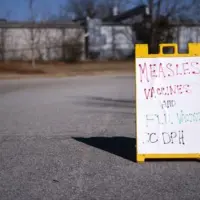
(NEW YORK) — Measles cases have topped 1,000 in the United States for the third time in 26 years.
At least 154 new measles cases have been confirmed in the last week for a total of 1,136, according to updated data from the Centers for Disease Control and Prevention (CDC).
So far this year, cases have been confirmed in 27 states: Arizona, California, Colorado, Florida, Georgia, Idaho, Illinois, Kentucky, Maine, Minnesota, Nebraska, New Mexico, New York, North Carolina, North Dakota, Ohio, Oklahoma, Oregon, Pennsylvania, South Carolina, South Dakota, Texas, Utah, Vermont, Virginia, Washington and Wisconsin.
Just six measles cases were reported among international travelers so far this year, according to CDC data.
About 92% of cases are among people who are unvaccinated or whose vaccination status is unknown, CDC data shows.
Meanwhile, 4% of cases are among those who have received just one dose of the measles, mumps, rubella (MMR) vaccine and 4% of cases are among those who received the recommended two doses, according to the CDC.
The current measles situation in the U.S. is partly being driven by a large outbreak in South Carolina that began last year, with 979 cases recorded as of Friday, according to state health officials.
Last year, the U.S. recorded 2,281 measles cases, which is the highest number of national cases in 33 years, according to the CDC. Before that, the last time measles cases rose above 1,000 was 2019 — CDC data showed 1,274 that year. Recorded cases dropped to a low of 13 in 2020, the first year of the COVID-19 pandemic.
It also marked the first U.S. deaths recorded from measles in a decade, two among school-aged unvaccinated children in Texas and a third of an unvaccinated adult in New Mexico.
The CDC currently recommends people receive two doses of the MMR vaccine, the first at ages 12 to 15 months and the second between 4 and 6 years old. One dose is 93% effective, and two doses are 97% effective against measles, according to the CDC.
However, federal data shows vaccination rates have been lagging in recent years. During the 2024-2025 school year, 92.5% of kindergartners received the MMR vaccine, according to data. This is lower than the 92.7% seen in the previous school year and the 95.2% seen in the 2019-2020 school year, before the COVID-19 pandemic.
Copyright © 2026, ABC Audio. All rights reserved.