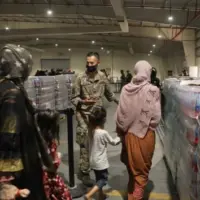
(NEW YORK) — More than 1,100 Afghan refugees and family members of active duty U.S. military personnel are stranded on an unused Doha military base that has become a target since the start of the U.S.-Israel war with Iran, according to U.S. non-profit organization Afghan Evac.
Qatar Armed Forces have been intercepting incoming attacks from Iran, but residents at the facility, known as Camp As Sayliyah, told ABC News they have been hiding in buildings during the attacks and were not initially given bunkers or proper protections to take cover.
During those weeks, they said shrapnel would fall into their bedrooms, even locations where young children were. Since the war broke out, refugees sent ABC News recordings in secret, outlining what they say are the dire conditions at the camp. They asked for their faces to be hidden and their voices altered, due to their fear of being deported or reprimanded.
Three weeks later, ABC News received videos where residents show how the camp installed new concrete walling near the entrances and exits of buildings. They say workers urge residents to enter the bunkers in the “event of a duck and cover alert.”
In response to the residents’ claims of terrible conditions, a spokesperson for the a U.S. State Department, which administers the base, also told ABC News they are “addressing all related operational concerns” including “the safety and security of American citizens as well as the safety of residents at Camp As Sayliyah.”
Mahidewran, a young Afghan mother, told us that her child’s first steps were taken in the camp, where the family has been for more than a year, and that raising her child there has been difficult.
“I’m not always able to provide her with the foods she needs or the toys she loves,” she said.
Her daughter was about to turn 1 when they were initially brought to Camp As Sayliyah, and now she is turning 2.
Apart from raising a child on a former military base, she faces another unlikely challenge: war.
Mahidewran told ABC News sirens go off every few hours in the camp, warning residents to take cover in their buildings.
“I left [Afghanistan] through a legal process by the United States, and when they transferred me to Qatar, we were given safety, an opportunity to rebuild our lives,” she told ABC News.
Ahmad, who said he fought against terrorism alongside the U.S. as a member of the Afghan Command forces, told ABC News his son sleeps under the bed, fearing for his life as missiles continue to fire at the camp.
He said he’s been living at Camp As Sayliyah with his children for more than 18 months, and despite being brought to Doha by the U.S. government, his entire family remains in limbo, not knowing where they will go next. ABC News spoke to refugees who shared similar stories to Ahmad’s — saying they were promised a better life in return for risking theirs when working for the U.S. government.
From July to August 2021, the U.S. evacuated more than 100,000 people out of Afghanistan during Operation Allies Refuge, following the withdrawal of U.S. troops during the Biden-Harris administration.
Nearly five years later, the Trump administration has halted relocation and refugee resettlement efforts, impacting many of those who had already been vetted and cleared to travel to the U.S., according to AfghanEvac. The reports detailing the operation have since been deleted from the State Department website.
Refugees at Camp As Sayliyah said that the U.S. government’s promise of a better life on American soil was broken and that being caught in another war brings them back to the terrifying moments they experienced in Afghanistan.
“We came from a country that was under war for 48 years, before living here we were living in constant fear and anxiety,” Farishta, a teenager living on the base with her parents, told ABC News.
When ABC News spoke with Farishta, she said she was still living in a state of fear and that a worker at the camp threatened her with deportation to Afghanistan if she spoke to a journalist again.
Farishta said she has lived at Camp As Sayliyah for 15 months and often dreams of her future, hoping to further her education.
“I feel hopeless because I am a girl who has been deprived of education and whose future is uncertain,” she said.
“Afghan Nationals at the camp do not currently have a viable pathway to the United States,” the department said.
The plan is to relocate the population to a third country by March 31, according to the department. It said this “is a positive resolution that provides safety for these remaining people to start a new life outside of Afghanistan.”
The State Dept said the “Trump administration has no plans to send these” Afghan refugees back to their home country.
However, those people ABC News spoke to said they have not been told what country they would be going to or when.
Afghan Evac said it has been advocating for refugees at the camp, writing several letters to the State Department, urging the government not to leave the residents at Camp As Sayliyah behind.
According to Afghan Evac, 800 of the people at the camp are fully vetted and approved refugees who were cleared to travel to the U.S. The camp’s residents are mainly women and children, it said.
Shawn VanDiver, the president of Afghan Evac, claimed that there was a pathway and that the State Department closed it off.
“There is no structural or legal barrier preventing these individuals from coming from the United States. The absence of a ‘viable pathway’ is a policy choice, not an inevitability,” he told ABC News.
Copyright © 2026, ABC Audio. All rights reserved.