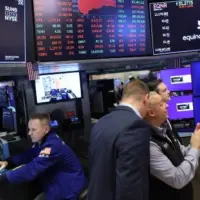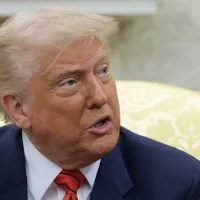
(NEW YORK) — Consumer attitudes soured in May for the fourth consecutive month, even as President Donald Trump dialed back some tariffs. The reading came in below the level economists expected.
Shopper sentiment now hovers near its lowest level since a severe bout of inflation three years ago, University of Michigan survey data on Friday showed. Before that, the measure of consumer attitudes hadn’t ever fallen this low.
The monthslong decline in consumer sentiment traces back to inflation fears and recession warnings set off by Trump’s initial rollout of levies.
A trade agreement between the U.S. and China this week slashed tit-for-tat tariffs between the world’s two largest economies and triggered a surge in the stock market. Within days, Wall Street firms softened their forecasts of a recession.
The U.S.-China accord marked the latest softening of Trump’s levies, coming weeks after the White House paused far-reaching “reciprocal tariffs” on dozens of countries. Trump also eased sector-specific tariffs targeting autos, and rolled back duties on some goods from Mexico and Canada.
The drawdown of tariffs coincided with data suggesting the economy remains in solid shape.
Inflation eased slightly last month, dropping to its lowest level since 2021, government data this week showed. Plus, the economy continues to add jobs at a solid pace.
Still, uncertainty looms over the economic outlook.
An array of tariffs remain in place, including an across-the-board 10% levy that applies to imports from nearly all countries. Additional tariffs have hit auto parts, as well as steel and aluminum.
Even after the pullback, a 30% tariff on China far exceeds the level before Trump took office, posing a risk of price increases for a large swathe of products that includes apparel, toys and some electronics.
Walmart executives on Thursday warned of tariff-driven price increases for perishable imports such as coffee, avocados, bananas and roses, as well as toys and electronics.
Consumers showed signs of weakness last month as retail sales slowed, indicating shoppers may be pulling back as they await possible fallout from tariffs. The trend poses a risk for the wider economy, since consumer spending accounts for roughly two-thirds of economic activity.
The U.S. economy shrank at the outset of this year, registering a sharp drop-off from robust growth over the final months of 2024.
But a surge of imports ahead of Trump’s tariffs likely clouded the figure, since the calculation subtracts imports in an effort to exclude foreign production from the calculation of gross domestic product. Analysts cautioned that a lowering of GDP on account of this trend would not reflect economic weakness.
Copyright © 2025, ABC Audio. All rights reserved.