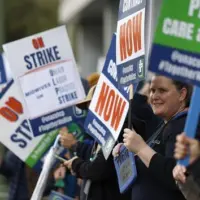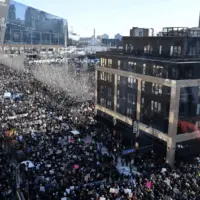
(NEW YORK) — Over the last several days, many Americans have seen upsetting, and often violent, images and videos of protests in Minneapolis amid a flood of ICE agents entering the city for a federal immigration enforcement operation.
Research has shown that images of extreme violence can impact mental health, increasing symptoms of anxiety and depression.
Among the videos and images that circulated widely in recent weeks have been the fatal shootings of two U.S. citizens involving federal agents just 17 days apart: Renee Good and Alex Pretti.
Psychologists and psychiatrists told ABC News that witnessing a death can add an extra level of distress for some people and lead to long-lasting consequences.
Symptoms of anxiety and depression
Studies have shown the symptoms of depression and anxiety can increase when exposed to negative news.
One 2011 study from the University of Sussex in Brighton, U.K., found that people had worsened mood and anxiety symptoms after just 14 minutes of negative news consumption.
Another 2022 study from Rutgers University, focused on COVID-19 news, found that greater daily exposure to news about the virus was linked to higher same-day and next-day worry about the pandemic as well as feelings of hopelessness and general worry.
Dr. Pierluigi Mancini, a psychologist and interim president and CEO of the nonprofit Mental Health America, told ABC News that witnessing any kind of violence whether through news, on social media or in person can lead to psychological effects
“So, people will experience fear, they’ll experience hypervigilance, they’ll experience emotional exhaustion, and they will have effects on their mental health,” he said.
Mancini added that witnessing violent events can activate the body’s “fight-or-flight response” which can include symptoms such as rapid heart rate, shallow breathing, nausea, irritability and difficulty concentrating, especially when the events happen in one’s own community.
“So, the individuals that are on site where they are witnessing these effects in their neighborhoods get affected at a much higher level, but even those millions more that end up watching it on social media or traditional news sites also have those experiences,” he said.
Witnessing deaths may be especially traumatic
Research has shown that mental health impacts are even more profound when someone’s unexpected death is witnessed and shared.
A May 2021 article looked at emotional and mental health impacts after the death of George Floyd, an unarmed Black man who was killed in Minneapolis in 2020 after a white police officer knelt on his neck.
The team analyzed Gallup poll data and found that in the week following Floyd’s death, more than one-third of respondents reported feelings of anger and sadness.
Researchers found a 1.5-fold increase in feelings of anger and a 1.3-fold increase in feelings of sadness compared to poll data for the four weeks preceding Floyd’s death. Increases were seen despite already elevated levels of anger and sadness due to the COVID-19 pandemic.
Johannes Eichstaedt, co-author of the study and an assistant professor in psychology at Stanford University, told ABC News he sees some similarities between the death of Floyd and the deaths of Good and Pretti, all of which occurred in Minneapolis.
He said there is scientific literature about linked fate, or the sensation someone has that a horrible event could have happened to them or someone they know.
“There is a very real fear response in the human body with lots of physiological consequences that are very real and when something like this happens and it’s recorded like this and then it traumatizes more or less everybody who watches this,” Eichstaedt said. “The problem is not that these things are getting captured in a video. The problem is that these things happen.”
Dr. Anthony Feinstein, a professor of psychiatry at the University of Toronto, told ABC News that witnessing a death can be distressing to anyone, but that it is important to determine when the stress becomes pathological.
“I think any individual with a moral compass would be distressed by seeing someone die like this on television,” he said. “It’s a very distressing thing to witness. And to feel momentary dismay and stress and sadness or anxiety in response to it strikes me as a normal human response to an abnormal event. Where it becomes problematic is when that stress and that distress doesn’t go away, when it lingers.”
Experts said witnessing deaths on the news, such as what occurred in Minneapolis, can elevate the level of potential mental health impacts, especially among those who are most vulnerable.
“It is extremely traumatic to see someone die,” Mancini said. “Once that sinks in that you witnessed someone lose their life, especially in a violent situation. It’s always traumatic even if you’re next to a loved one who’s passing and you’re expecting it, but when it’s unexpected and when it is violent, it is extremely difficult to watch and to process.”
Mancini said some people may be desensitized to violence, but others can be severely impacted. Witnessing violence can violate a person’s feeling of safety and stability, he said.
“In Minnesota, many people are experiencing that escalating stress,” he said. “They’re experiencing that fear, that violence and uncertainty in their communities. So, it’s gonna make you question everything that you were taught when you were growing up.”
How to protect mental health
For those who are experiencing mental health impacts, experts say there are steps people can take to protect their mental health.
Rather than avoiding the news altogether, Mancini said people can purposely limit the time they spend watching news coverage.
He added that watching the news is important to remain informed, but that it is just as important to have intentional engagement.
“So, for example, it is as simple as maybe … I will watch the news two times a day, and when I’m watching this news, I’m going to set a timer,” he said. “I’m gonna limit the time that I’m to be watching this news. That is the healthy thing to do.”
To limit mental health impacts, people can also take action by getting involved with a group focused on the issues they are most passionate about or joining an affinity group, which are supportive communities of people who share a common identity, experts said.
Feinstein said having psychosocial supports can help people maintain mental well-being and allow them to be more vulnerable as well.
“Peer support is important and there is literature out there that peer support is comforting and it’s protective and it’s helpful when it comes to managing situations like this,” Feinstein said. “Obviously you want to keep your responses within the letter of the law … but being part of a support group is helpful.”
Feinstein added that, in stressful times, it’s important for people to devote sufficient time to things that are healthy and meaningful in their lives, whether it be friendships, hobbies or interests.
“And, by the way, don’t feel guilty by doing it,” he said. “That’s really important. People feel, ‘Well, I’ve got a good life, and I feel guilty that I can go to the cinema and theater with other people.’ No, it’s really important that you hold on to those good positive things, because that’s how you maintain your mental well-being.”
Copyright © 2026, ABC Audio. All rights reserved.